Iowa Hail Season Just Ended : Here's Why Roof Damage Is Still Hiding Overhead
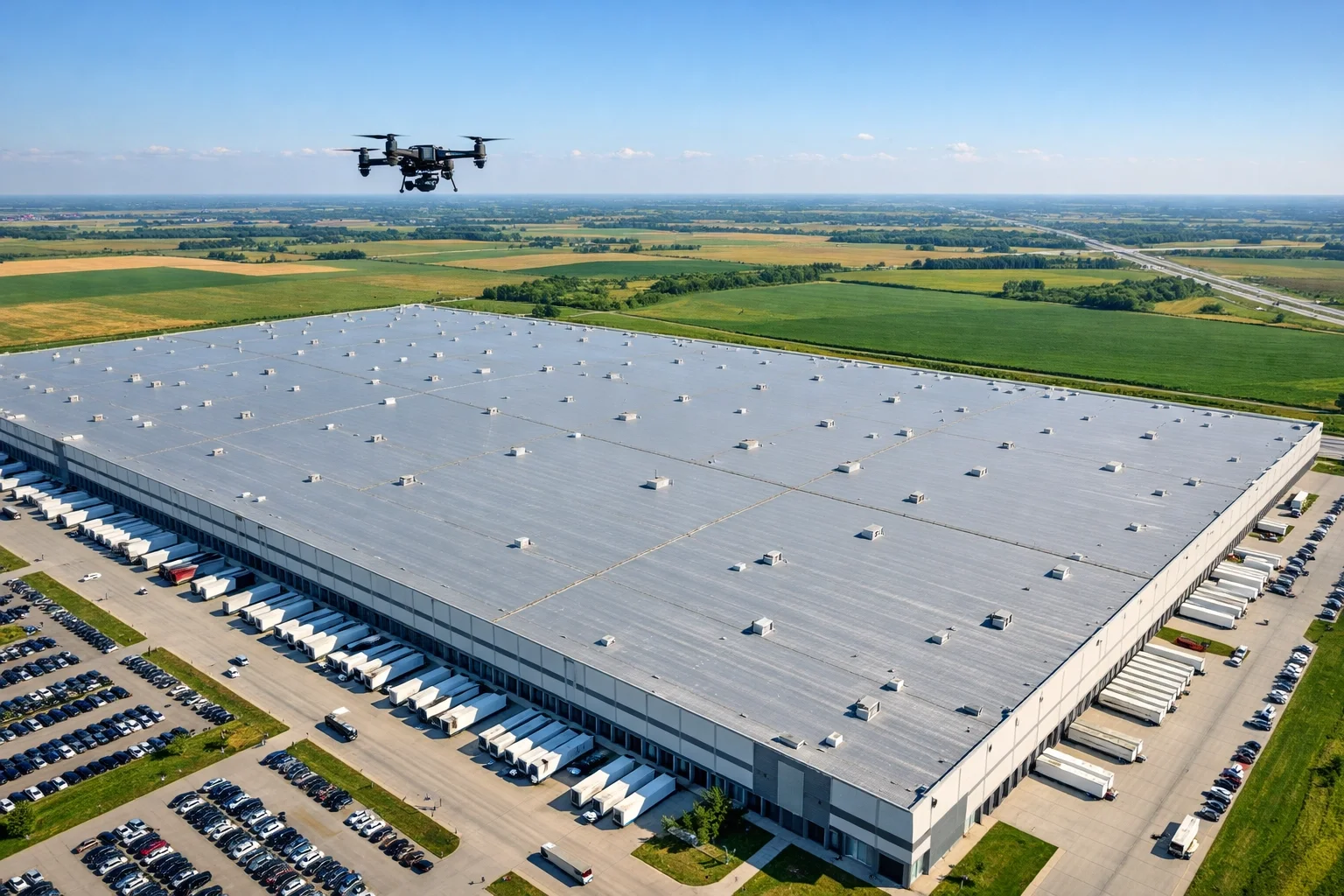
September is the decision window for many Iowa property managers and insurance professionals. Summer hailstorms have passed, but the work of identifying damage, documenting losses, and deciding which roofs require closer attention is still underway.
A ground-level walk-around rarely tells the complete story on a large commercial roof. Granule loss, membrane tears, flashing damage, seam failures, and impact marks around rooftop equipment can remain invisible from the parking lot.
A professional drone roof inspection in Iowa gives you direct visual access to difficult and dangerous roof areas without placing personnel on steep surfaces or requiring lifts, scaffolding, or facility shutdowns.
September is when unresolved roof damage becomes an operational risk
Hail damage does not always create an immediate interior leak. A commercial roof may continue to shed water after a storm even when hail has weakened the membrane, displaced protective granules, or damaged flashing.
That creates a timing problem. If the condition is not documented before winter, freeze-thaw cycles, snow accumulation, and ice can make the original damage more difficult to identify.
The Iowa Insurance Division recommends prompt communication with your insurer and careful review of your policy requirements after hail events. Your policy controls notice deadlines, deductibles, exclusions, and documentation requirements, so review it before assuming a claim timeline. Read the Iowa Insurance Division’s hail claims guidance.
For September claims review, your documentation should connect three facts:
Where the property is located
When the hail event occurred
What physical roof conditions are present now
Aerial imaging does not replace your insurer’s process or a roofing contractor’s technical evaluation. It gives those professionals a clearer, organized record of the roof’s condition.
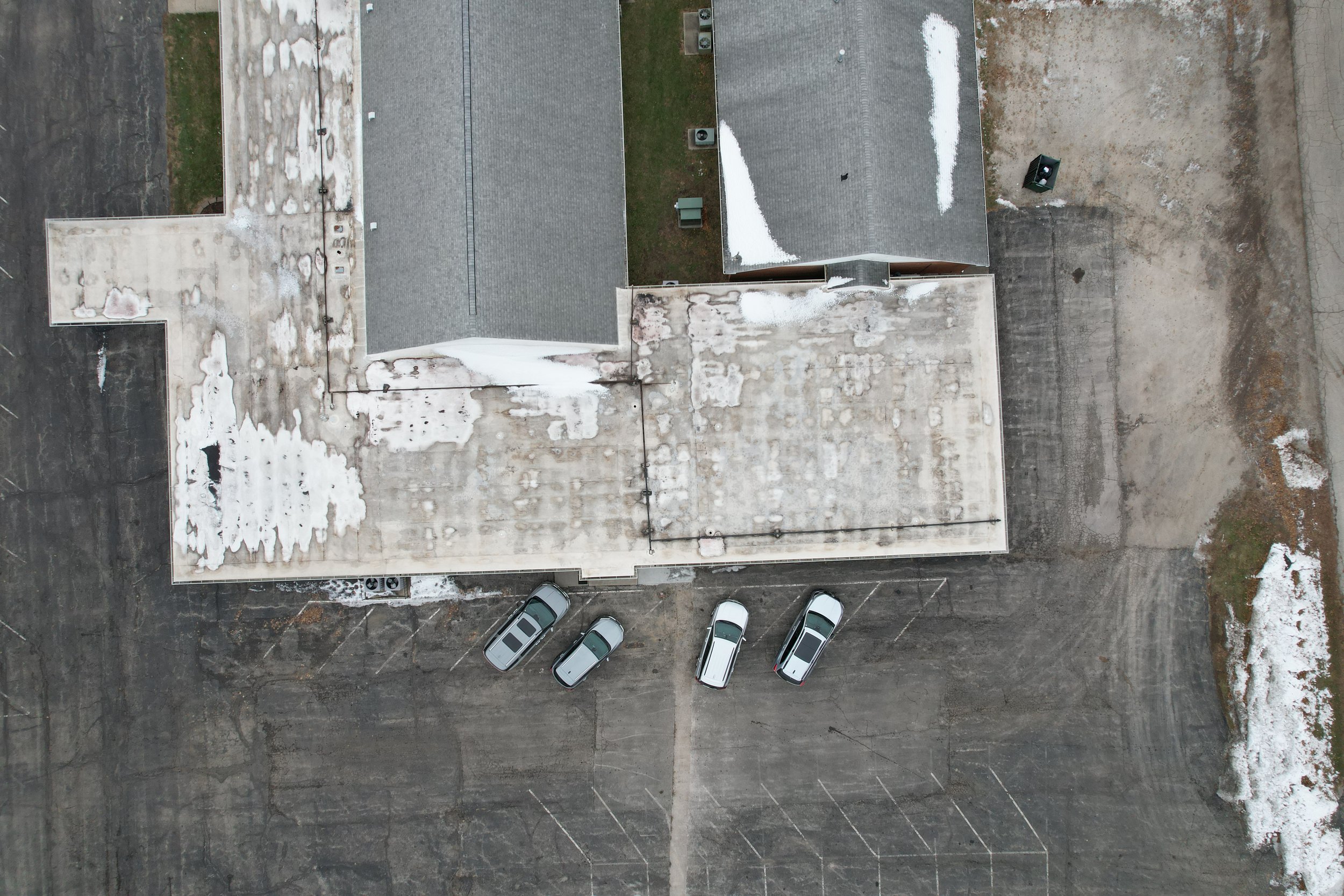
Large commercial roofs hide damage in predictable locations
A roof does not need to look destroyed to require attention. Hail damage is often distributed across broad areas or concentrated around components that are difficult to inspect from the ground.
A detailed commercial drone inspection examines areas such as:
Membrane fields: Impact marks, punctures, tears, coating loss, and surface irregularities
Modified bitumen and built-up roofing: Surface damage, displaced cap material, and exposed reinforcement
TPO and EPDM systems: Possible punctures, seam concerns, membrane separation, and damaged flashing
Metal roof panels: Dents, coating damage, fastener areas, and panel deformation
Parapets and edge metal: Bent coping, damaged counterflashing, and compromised edge details
Roof penetrations: Vents, skylights, pipe boots, and mechanical equipment curbs
Drainage systems: Blocked drains, damaged scuppers, ponding areas, and debris accumulation
Asphalt shingle sections: Granule loss, bruising, cracking, displaced shingles, and exposed asphalt mat
Ground-level checks may identify dents in gutters or damage to siding. Those observations are useful, but they do not show the full roof surface.
4K imaging reveals conditions that a parking-lot check misses
A commercial roof inspection depends on more than altitude. The camera must produce enough detail to show the condition of seams, flashing, penetrations, drainage points, and surface materials.
Studio 5 Drone Productions uses ultra-HD 4K imaging to capture both broad roof coverage and close visual details. The workflow combines elevated overview images with lower-angle passes that show roof geometry and component relationships.
This helps identify:
Subtle tears or punctures in exposed membrane
Irregular seams and flashing transitions
Granule loss across multiple roof slopes
Debris collecting around drains and equipment
Ponding indicators and drainage obstructions
Damage to roof edges that is difficult to see from below
Condition changes between inspection dates
For larger properties, organized aerial mapping can also create a consistent visual record of roof sections. When appropriate, an orthomosaic or indexed image set helps facility teams locate specific areas quickly and compare conditions during future inspections.
The result is not a collection of random photographs. It is a structured visual record that supports maintenance planning, repair coordination, and insurance review.
Strong claims documentation requires location, timing, and context
An insurer or roofing professional needs more than a close-up image with no identifying information. Useful documentation should show where an image was captured, which roof section it represents, and how the condition relates to the reported storm.
A professional aerial documentation package should include:
Date and approximate time of capture
Property address and roof section identification
Wide images showing the building and roof layout
Close images of suspected hail impacts or material damage
Images of roof edges, penetrations, flashing, and drainage areas
Consistent file names or organized folders
Notes identifying areas that require physical follow-up
Before-and-after images when prior records are available
You can also compare the inspection date with official weather information. The NOAA Storm Events Database provides historical storm information, while local National Weather Service reports may help establish whether hail was reported near the property.
Aerial imagery supports the claim record; it does not guarantee claim approval. Your insurer, roofing contractor, engineer, or other qualified professional determines the required next steps.
A commercial drone inspection reduces exposure and disruption
Traditional roof access often involves ladders, harnesses, lifts, scaffolding, or personnel walking across fragile surfaces. Those activities introduce additional safety planning, scheduling requirements, and potential disruption to tenants, employees, customers, and vehicles.
A drone inspection keeps personnel on the ground while the aircraft captures roof-level imagery. This approach is especially valuable for:
Warehouses and distribution centers
Manufacturing facilities
Retail centers
Schools and athletic facilities
Office buildings
Multi-building commercial properties
Industrial sites with restricted access
Facilities with active loading docks or heavy vehicle traffic
Because a drone does not require a lift to reach most roof areas, the process is safer and more cost-effective than many traditional access methods. It also allows you to evaluate multiple buildings without coordinating an extended shutdown.
The inspection still requires professional judgment. Aerial imaging does not replace moisture testing, core sampling, physical probing, or repairs by a qualified roofing professional when those services are necessary.
FAA Part 107 compliance protects your project
Commercial drone operations must be conducted by a properly credentialed remote pilot. Studio 5 Drone Productions operates with FAA Part 107-certified pilots who understand airspace restrictions, operating limitations, weather conditions, and site-specific flight risks.
FAA Part 107 generally limits small unmanned aircraft to 400 feet above ground level, subject to applicable rules and exceptions. Flights near airports, controlled airspace, temporary flight restrictions, or other sensitive areas may require additional authorization or operational planning.
Before launching, a professional operator should account for:
Airspace classification
Airport proximity
Current restrictions and notices
Weather and visibility
Obstacles, power lines, and rooftop equipment
People, vehicles, and neighboring properties
Visual line-of-sight requirements
Safe takeoff and landing locations
You can review the company’s approach to certification and compliance in Is Your Drone Pilot FAA-Compliant?.
Direct access means faster answers after the storm
When you hire a national marketplace, your project may pass through multiple coordinators before reaching a pilot. That creates unnecessary middlemen, slower communication, and limited accountability.
Studio 5 Drone Productions provides direct access to the owners and operators responsible for the work. You receive a local partner who understands Iowa weather conditions, commercial properties, airspace requirements, and the urgency of post-storm documentation.
Our service coverage includes Iowa and Northern Missouri, with fast turnaround for property managers, facility teams, contractors, and insurance professionals who need usable information before winter conditions arrive.
Learn more about the advantages of working with a local provider in Why Choose Studio 5 Drone Productions Instead of a National Drone Company.
What to prepare before scheduling a roof inspection
To keep the process efficient, gather:
Property address and site contact
Building count and approximate roof size
Roof system type, if known
Date of the suspected hail event
Existing roof plans, maintenance records, or prior imagery
Areas where leaks or interior staining appeared
Insurer, adjuster, or roofing contractor contact information
Any access restrictions or tenant scheduling requirements
This information allows the flight plan and deliverables to match your operational needs.
Technical standards you can expect
Certification: FAA Part 107-certified commercial pilots
Imaging: Ultra-HD 4K aerial photography and video
Documentation: Organized roof imagery for maintenance and claims review
Mapping: Aerial site mapping and orthomosaic products when appropriate
Safety: Ground-based inspection workflow that reduces roof-access exposure
Turnaround: Fast delivery for time-sensitive post-storm decisions
Coverage: Iowa and Northern Missouri
Accountability: Direct communication with Studio 5 Drone Productions
September is not the time to assume that a roof is undamaged because no leak has appeared. Schedule a professional commercial drone inspection now, document the roof before winter, and give your maintenance or claims team the visual information needed to act with confidence.
Contact Studio 5 Drone Productions to discuss a drone roof inspection in Iowa or Northern Missouri.